Our Editorial Standards: Fact-Checking, Sourcing, and Corrections
Anyone can publish anything now. That's the defining fact of modern media, and it's exactly why standards matter more than they used to, not less. What separates journalism from the endless churn of content isn't the topic or the tone — it's the invisible machinery underneath: the checking, the sourcing, the willingness to be corrected. This piece describes that machinery at Inkego, in plain terms, so you can judge us by it.
Fact-checking
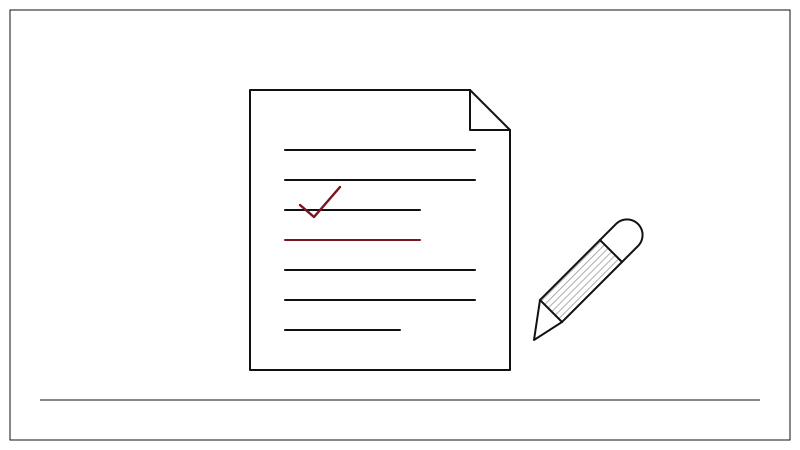
Every claim of fact in an Inkego piece is checked before publication. That includes the obvious things — names, titles, dates, affiliations, numbers — and the less obvious ones, like whether a study actually says what a subject remembers it saying.
In practice, a checker works through the draft line by line against primary sources: the paper itself, the filing, the transcript of the interview. Where a subject asserts something we can't independently verify, we don't launder it into a statement of fact. We attribute it clearly as their claim or their view, so a reader always knows the difference between "this is true" and "this is what she believes."
A fact-check isn't about doubting the expert. It's about making sure that when we say something is true, it actually is.
Sourcing
We prefer named, on-the-record sources and primary documents. When we rely on someone's account, we say whose account it is. We use anonymity sparingly and only for good reason — for example, to protect someone from genuine professional or personal risk — and never simply to let a source take a shot at a rival without accountability.
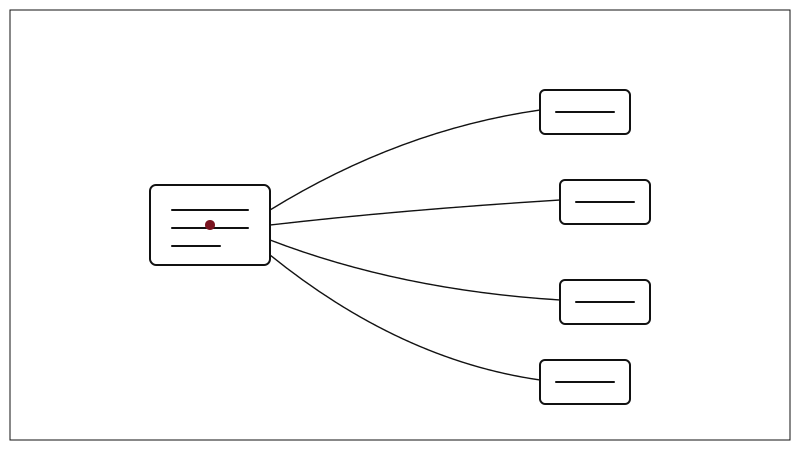
For technical stories, primary sources are the backbone: the published study, the patent, the dataset, the code. Secondary commentary is useful for context, but we try to trace claims back to where they originate rather than repeating a chain of citations that no one has actually read.
Independence and conflicts of interest
We are not a public-relations agency and we are not an advertising business. No money changes hands with the subjects of our stories — they don't pay us and we don't pay them — which removes the most common source of editorial compromise. If you want the full reasoning, we laid it out in Why Our Interviews Are Free.
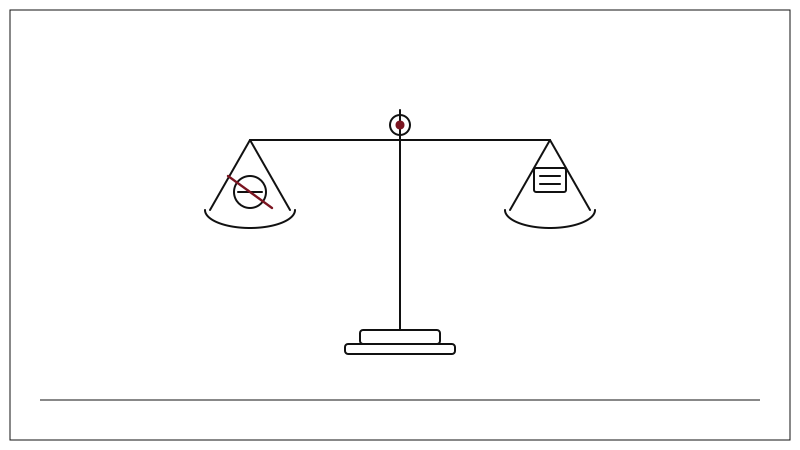
Where a relationship could reasonably affect how a reader weighs a story — a prior working relationship, a shared investor, anything that might look like a thumb on the scale — we disclose it. Our editors, not our subjects and not our publishing partners, decide what runs and how it's framed.
Subject review
Every subject sees their piece before it's published and can correct facts and request reasonable edits. This is a genuine protection, not a courtesy, and it's bounded by a firm rule: review is for accuracy and fairness, not for turning journalism into promotion. We wrote a dedicated explainer on exactly how this works — You'll Always See the Draft.
Corrections
We get things wrong sometimes. Everyone who publishes does. What matters is what happens next. Our policy is simple:
- We correct promptly. When we learn of a material error, we fix it as soon as we've verified the correct information.
- We correct on the record. Substantive corrections are noted, not silently edited away, so the record is honest about what changed.
- We coordinate with the outlet. Because our stories run in partner publications, we work with the outlet to make sure the correction appears where the original did.
If you spot an error in something we've published, tell us at editorial@inkego.com. We'd genuinely rather hear it from you than leave it standing.
Anonymity and off-the-record material
Most of our work is firmly on the record — that's the point of an expert byline. But occasionally a source shares something valuable on condition of anonymity, or a subject tells us something they don't want published. We treat those agreements as binding. If we agree that a remark is off the record, it stays off the record, full stop; we don't quietly use it as "background" to shape the piece in a way the source would object to.
When we do grant anonymity, we do it deliberately and we explain to readers, in general terms, why — for instance, "a researcher who was not authorized to speak publicly." Readers deserve to understand why they're being asked to trust an unnamed voice, and we deserve the discipline of having to justify it to ourselves before we extend it.
The limits of what we cover
Standards also mean knowing what we're not. We are a features-and-interviews newsroom focused on experts and their work; we are not an investigative unit chasing wrongdoing, and we don't pretend to be. When a story starts to touch on serious allegations that would require adversarial investigation to handle responsibly, we're honest about whether it's the right story for us. Overreaching into work you're not equipped to do properly is itself a failure of standards. Knowing your lane is part of the job.
Quotes and context
We quote people accurately. Light cleanup of verbal filler — the "ums," a false start — is standard and doesn't change meaning. What we don't do is stitch together fragments to manufacture a sentence someone never said, or drop the context that makes a quote fair. If tightening a quote for length risks changing its sense, we don't tighten it.
Who checks the checkers
Standards are only as good as the people accountable for them, so it's worth being explicit about accountability. Every piece has a named author and passes through an editor before it leaves our desk; the two are never the same person. That second pair of eyes isn't a formality — it's where framing gets challenged, weak sourcing gets caught, and the writer's blind spots get named by someone who wasn't in the room for the interview.
Above that, editorial decisions ultimately rest with our editor-in-chief, not with a commercial team and not with our publishing partners. The people who sell our work to outlets do not get to overrule the people who report it. That separation between the editorial and commercial sides of the house is old-fashioned, and it's deliberate: it's the structural reason a partner outlet can trust that what we send them reflects our best judgment rather than our biggest invoice.
Why we publish this
Standards that live only in an internal handbook are easy to bend. Writing them down in public makes them a commitment we can be held to — by our subjects, by our publishing partners, and by readers. It's also, we think, the most honest answer to the question that brings many people to this site in the first place: is this legitimate? A scam doesn't publish its correction policy. A newsroom does.
There's a second reason, less about defence and more about aspiration. Standards are how a young newsroom earns the right to be trusted before it has decades of reputation to lean on. We can't ask you to trust us on the strength of a long history, because we're building that history now. What we can do is show our work — spell out exactly how we operate, invite you to hold us to it, and then do it consistently, piece after piece, until the track record speaks for itself. Published standards are the promissory note; every accurate, fairly reported story is a payment against it.
You can see the short version of all this on our About page, and meet the editors who apply it every day.

Eleanor leads the Inkego newsroom and owns its editorial standards. Read her profile →