Why Our Interviews Are Free — and Why No Money Changes Hands
"Free" is one of the most suspicious words in the English language. We know that. When someone offers you something valuable — in our case, a professionally reported interview or feature that runs in a real publication — and asks for nothing in return, your instinct should be to look for the catch. So let's talk about the catch, because being straight about it is the whole point of this piece.
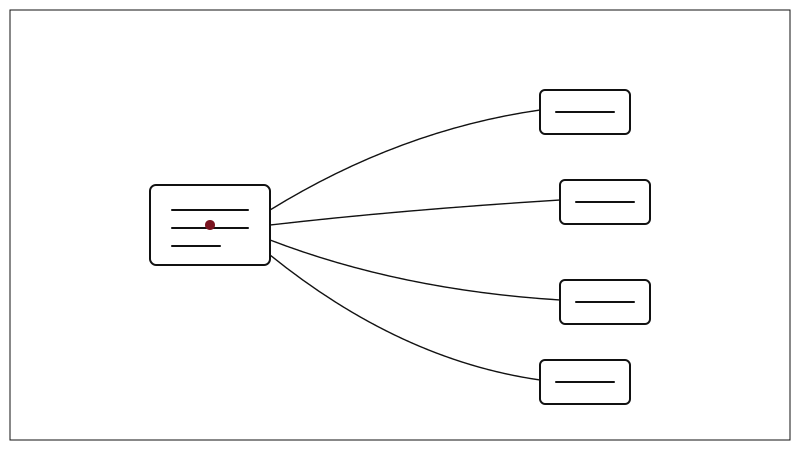
Here is the entire arrangement in one sentence: you don't pay us, we don't pay you, and we earn our money by syndicating finished stories to the publications we partner with. That's it. Everything else is detail.
You are not our customer
Most confusion about "free" comes from a single wrong assumption: that you're the customer. In our model, you're not. The publications are. They want a steady supply of high-quality, ready-to-run stories about interesting experts, and producing that well is hard. We do it, and they pay us for it.
That means the value flows in a circle that doesn't run through your wallet. We invest time interviewing you and writing the piece. The publication pays us to run it. You get the coverage. Nobody needs to charge you, because you were never the source of the revenue.
Once you understand who's paying whom, "free" stops being suspicious and starts being obvious.
Why we don't pay you either
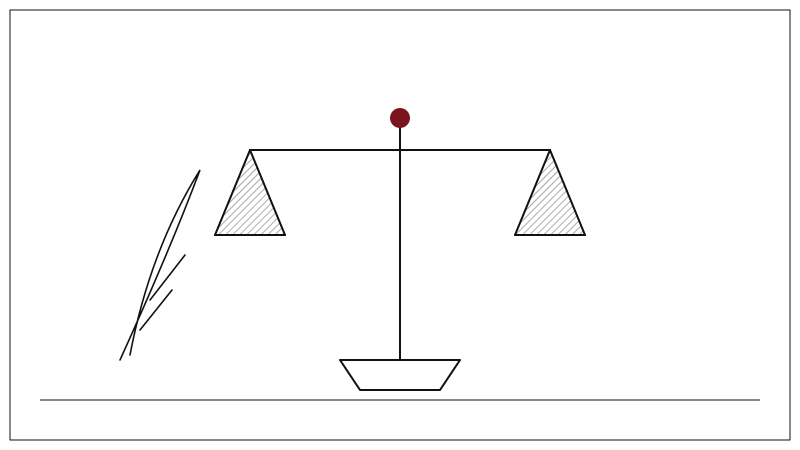
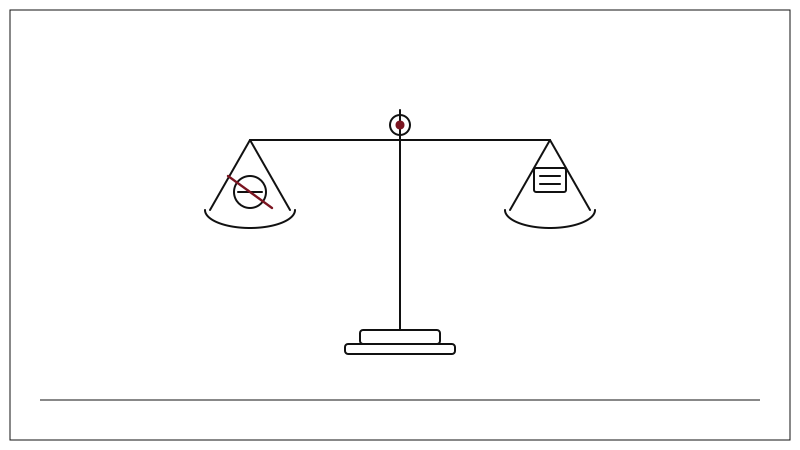
The flip side surprises some people: if this is worth money to publications, why don't we pay the subject? The answer is about independence. The moment money flows to an interview subject, the story stops being journalism and becomes something closer to advertising — and publications, rightly, won't run advertising dressed up as editorial. Paying subjects would destroy the very thing that makes the coverage valuable to you.
So we keep it clean. No payment in either direction means the piece is unambiguously editorial. That's better for the publication, better for readers, and — because a genuine editorial byline carries far more weight than a paid placement — better for you.
What you actually get
If not money, then what? Three things, mainly:
- A real byline in a real publication. Not a post on our site, not a press release on a wire — an article in an outlet with an audience and an editorial reputation.
- Credibility that compounds. Being interviewed as an expert is a durable signal. It shows up in searches, on your profile, and in the minds of people deciding whether to trust you.
- Shareable proof. After publication we give you a link and "as featured in" assets to use however you like.
For most experts, that's worth far more than a modest interview fee would be — and it doesn't compromise anyone's independence.
Why this isn't "if it's free, you're the product"
There's a well-worn internet saying: if you're not paying for the product, you are the product. It's a useful warning about services that monetize your attention or harvest your data. But it doesn't describe what happens here, and it's worth explaining why, because the phrase makes people reflexively suspicious of anything free.
In the "you are the product" model, a company gives you something at no charge and then sells you — your attention, your behaviour, your personal information — to someone else. We don't do that. We don't run ads against you, we don't build a profile of you, and we don't sell your contact details. The thing we sell is a finished piece of journalism that you have read and approved. You're not the product; the story is. And crucially, you hold a veto over that story right up until publication.
That distinction matters because it changes where your leverage sits. In a data-harvesting arrangement, the user has almost no control once they've signed up. In ours, the subject controls the single most important thing — whether the piece runs at all. That's the opposite of being the product.
How the money actually works
To be concrete: a publication commissions or buys a finished piece from us, or licenses it as part of an ongoing arrangement. We handle rights, embargoes, and attribution so the outlet can run it cleanly. Our margin is the difference between what it costs us to produce excellent journalism and what publications will pay for it. If you want the full walkthrough, we wrote a dedicated explainer: How Syndication Works.
We're happy to say all of this out loud because transparency is a competitive advantage in a field crowded with vague operators. The scammy version of what we do hides the money. We point at it.
Why not just charge a small fee?
Occasionally someone suggests we'd seem more legitimate if we charged something — a token fee to prove we're a real business. It's an understandable instinct, and it's exactly wrong, for two reasons.
First, the moment a subject pays us, the incentive inverts. If our revenue came from the people we cover, we'd have every reason to say yes to anyone with a chequebook regardless of whether they had a real story — and publications would immediately stop trusting our work, because "pay to be covered" is the definition of an advertorial. Charging subjects would quietly destroy the product. Second, a fee would exclude precisely the people we most want: the working researcher, the early-stage founder, the expert who's brilliant but not wealthy. We'd trade a broad pool of substance for a narrow pool of people willing and able to pay, which is the opposite of what makes for good journalism. Free isn't a marketing gimmick here. It's structurally necessary for the whole thing to work.
The questions people ask next
"So you'll write whatever makes me look good?"
No. We'll write a fair, accurate story that you get to review for errors. If your goal is uncritical promotion, an ad or a sponsored post is the honest tool for that — not us.
"Will you sell my data?"
No. We collect what we need to produce and publish the story, nothing more. Our privacy policy spells this out.
"What if I don't like the result?"
You see the draft first and can correct anything inaccurate. If we can't reach something we're both comfortable with, the piece doesn't run. You are never trapped.
The bottom line
Free doesn't mean worthless and it doesn't mean a trap. In our case it means a business model where the people being interviewed simply aren't the ones being billed. If that still feels too good to be true, do what we'd do: check the people behind it, read our standards, and ask us anything. We'd rather earn your trust with a straight answer than lose it with a slick one.
And if you take nothing else from this: the direction money flows tells you almost everything about a piece of media. When the subject pays, you're looking at an advertisement, however it's dressed up in editorial clothing. When the publisher pays and the subject pays nothing, you're looking at genuine editorial. We built the second kind on purpose, and being able to say so plainly — with no asterisk, no hidden fee, and no small print buried at the bottom of a contract — is exactly the point of this whole piece.

Marcus runs production and the partner-publisher network. Read his profile →