How Syndication Works: From Our Desk to a Publisher's Column
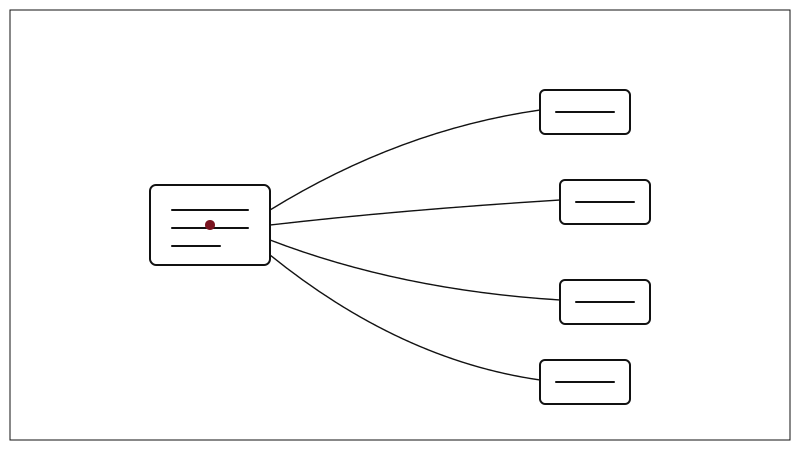
"Syndication" is one of those industry words that sounds more complicated than it is. Strip away the jargon and it's just this: a piece of journalism produced in one place is published in another. It's how a newspaper column appears in a hundred papers at once, and it's how our stories reach audiences far larger than any single outlet — or any single expert — could reach alone. Here's how it actually works at Inkego, start to finish.
Where a story begins
Every syndicated piece starts the same way: with an idea and an expert. Sometimes our editors spot a researcher whose work deserves a wider audience; sometimes an expert puts themselves forward. Either way, before a single word is written, I'm already thinking about the destination — which publications cover this beat, what formats their columns take, and whether there's genuine appetite for the story.
That matters because a story produced with no home in mind tends to find no home at all. Matching happens early, at least loosely, so we're building something a real outlet will actually want.
Producing to a publishable standard
We then report, write, fact-check, and run the piece through subject review. By the time a story leaves our desk it is genuinely finished — copy-edited, verified, and cleared. This is the part that makes syndication work: an outlet isn't buying a rough idea it has to rescue, it's receiving a piece it can publish more or less as-is. That's the product.
The whole value of syndication rests on one promise to the publisher: what we send you is ready to run.
Matching the story to an outlet
With a finished piece in hand, I place it with the partner whose audience fits best. A deep computational-biology interview belongs somewhere different from a founder profile or a crypto-infrastructure explainer, and part of my job is knowing those differences cold. We'd rather place a story in the right outlet than the biggest one.
For the subject, this is the moment the abstract becomes concrete: we tell you which publication will run the piece and roughly when.
Rights, embargoes, and attribution
This is where syndication gets technical, so let me demystify the three terms you'll hear most:
- Rights. We agree what the outlet can do with the piece. Often that's "first rights" (they publish it first) or "exclusive rights" for a period (only they run it for a while). Clear rights mean nobody is surprised later.
- Embargo. Sometimes a story is tied to an event — a product launch, a paper's publication. An embargo is simply an agreed date and time before which nobody publishes. It keeps everyone coordinated.
- Attribution. Who gets named, and how. Our pieces carry a real byline, and we agree with the outlet how Inkego and the author are credited.
Handling all of this is precisely what publishers pay us for. They get editorial-grade material without the overhead of sourcing, producing, and negotiating each piece themselves.
Exclusive versus non-exclusive, in practice
The question I'm asked most often — by publishers and subjects alike — is what "exclusive" really means and whether it limits where a story can travel. So let me be concrete. When an outlet takes a piece on a first-rights or exclusive basis, they're paying for the privilege of being the one place readers encounter it, at least for a window of time. That exclusivity is part of what makes the piece valuable to them: nobody wants to run something their competitor published yesterday.
For the subject, this rarely matters in the way they fear. A story doesn't need to appear in ten places to do its job; it needs to appear in the right place, credibly, once. A single well-placed piece in a respected outlet does more for an expert's reputation than the same words scattered across a dozen minor sites. And after any exclusivity window lapses, there's often room for a piece to be referenced, excerpted, or linked more widely — with the subject free to share it however they like from day one.
Non-exclusive arrangements exist too, usually for more evergreen explainer content where several outlets might each want a version for their own audience. We agree which model applies before we produce anything, so there are never surprises on either side.
Why quality is the whole business
It's worth dwelling on why we invest so heavily in production before a single dollar arrives. In a lot of the "content" economy, the incentive runs the other way: produce as cheaply as possible and let volume do the work. That model is corrosive, and publishers can smell it. A story that arrives thin, unchecked, or lightly disguised as promotion creates work for the outlet rather than saving it — and it damages the trust that makes them willing to take our next pitch.
So our economics only function if the quality is genuinely there. An editor at a partner publication has to be able to read one of our pieces and think, "I could run this today." That standard — reported, verified, subject-reviewed, cleanly written — is not a nice-to-have layered on top of the business. It is the business. It's why the same outlets come back, and it's why a story about you rides on a reputation rather than a cold submission.
Publication — and what happens after
The outlet publishes the piece in its column, on its site, under the terms we agreed. For the subject, that's the payoff: a story about your work, in a publication people read, with your name on it. We send you the link and a set of "as featured in" assets to use however you like.
If a correction is ever needed after publication, we coordinate it with the outlet directly, following the process in our editorial standards. The relationship doesn't end at "publish."
What syndication is not
Because the word gets misused, let me clear up two things it doesn't mean here. It isn't a wire service dumping identical press releases into a hundred inboxes — every piece we place is original journalism, produced once, matched deliberately to one home. And it isn't "content marketing" wearing a journalist's hat. A sponsored post is paid for by its subject and exists to promote them; a syndicated Inkego story is paid for by the outlet that runs it and exists to inform that outlet's readers. Those are opposite arrangements that happen to share some vocabulary, and conflating them is exactly the confusion we try to dispel.
The practical test is simple: follow the money. In advertising, the subject pays to appear. In our model, the subject pays nothing and the publisher pays us for the finished work. That single difference is what lets an outlet run our piece as editorial rather than label it as an ad — and it's what makes the coverage worth having in the first place.
Why this model is worth understanding
For subjects, understanding syndication answers the question behind so much hesitation: where is this actually going to appear, and why would a real publication run it? The answer is that we've built the relationships and the production quality that make outlets want our work. Your story rides on that infrastructure.
For publishers, it's a straightforward proposition: a reliable pipeline of original, verified, ready-to-run stories across six verticals, with clean rights and no surprises. If that's you, the details live on our Publishers page and in the Media Kit — or you can just email me at partnerships@inkego.com.
Either way, there's nothing hidden in how this works. Syndication is old, well-understood plumbing. We've just tried to run it cleanly.

Sophie works with publishers on commissioning and syndication. Read her profile →