Inside the Lab: A Biologist on Reading the Cell's Hidden Signals
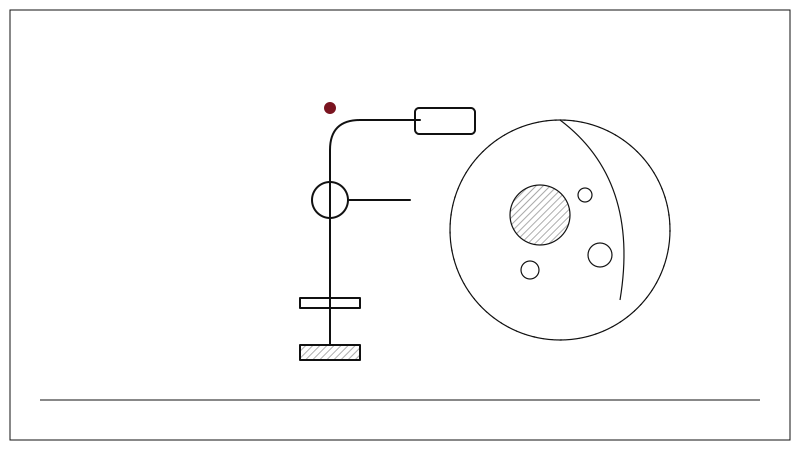
Dr. Naomi Feldman runs a cell-signalling laboratory in a building that smells faintly of coffee and ethanol, where a dozen researchers spend their days watching molecules make decisions. Her work sits in a corner of biology that rarely produces a headline: signal transduction, the process by which a cell senses what's happening outside its walls and decides what to do about it. It is, she argues, one of the most consequential subjects in all of medicine — and one of the least understood by the public.
I spent an afternoon with Feldman to understand what her lab actually does, why the discoveries that matter most are so often invisible, and what it's like to spend a career on questions that resolve slowly, if at all. What follows is a lightly edited transcript of our conversation.
The work
Let's start simply. If a smart friend asked what your lab does, what would you say?
I'd say we study how cells listen. Every cell in your body is constantly being bombarded with signals — hormones, growth factors, stress signals, messages from neighbouring cells. On its own, a single molecule bumping into a receptor means nothing. But cells have evolved these extraordinary relay systems that take that one event and turn it into a decision: divide, or don't. Move, or stay. Live, or die. We study the relays.
"Live or die" sounds dramatic for something happening in a dish.
It's the least dramatic dramatic thing in the world. [laughs] A cell deciding to die on schedule is one of the most important things your body does. When that decision-making breaks — when a cell that should die keeps living and dividing — that's the beginning of a tumour. So the pathways we study are exactly the ones that go wrong in cancer, in autoimmune disease, in a lot of what shortens human lives. We're not curing anything directly. We're trying to read the wiring diagram.
A cell deciding to die on schedule is one of the most important things your body does. Dr. Naomi Feldman
The pace of discovery
You've said publicly that most of your important results never make the news. Why?
Because they're incremental, and incremental doesn't photograph well. The public image of science is a eureka moment — someone shouts in a lab and the world changes. That almost never happens. What actually happens is that you nail down one more component of a pathway, you show that molecule A modifies molecule B under these specific conditions, and it takes you two years and it moves the field forward by a couple of percent. Multiply that by ten thousand labs and you get real progress. But no single paper is a story in the way a journalist wants a story.
Does that bother you?
It used to. Early in my career I wanted the big splashy result. Now I find the incremental part almost comforting. It means the knowledge is durable. A flashy result that turns out to be wrong — and there are plenty — sets the field back. A carefully established small fact stays true. I'd rather add one brick that holds than announce a cathedral that collapses.
On tools and technique
How has the actual day-to-day of watching cells changed over your career?
Enormously, and it's the part outsiders never ask about. When I started, if you wanted to know whether a protein was active, you basically ground up a million cells and measured an average. You got one number for the whole population. The problem is that averages lie — a population where half the cells scream and half are silent looks identical to one where every cell murmurs. We were making confident claims about behaviour we literally could not see.
Now we can watch single living cells over time, tag individual molecules, and see the variation. And the variation turned out to be the story. Cells that look identical respond completely differently to the same signal, and that noise isn't a measurement error — it's biologically meaningful. Whole conclusions from the averaging era had to be revisited. That's humbling and thrilling at once.
Does better technology just create more questions?
Always. Every tool that lets you see more finely reveals a layer of structure you didn't know to ask about. I used to find that exhausting; now I think it's the most reassuring thing about science. If our tools ever stopped generating new questions, it would mean we'd hit the bottom, and biology has shown no sign of having a bottom. There's always another floor down.
The variation turned out to be the story. Cells that look identical respond completely differently — and that noise isn't error, it's meaning. Dr. Naomi Feldman
What outsiders get wrong
What's the most common misconception you encounter about your field?
That biology is like engineering — that if we just map everything, we'll be able to design the outcome we want. Cells aren't circuits. They're messy, redundant, context-dependent systems shaped by three billion years of evolution with no designer and no documentation. The same signal can mean opposite things depending on the cell's history, its neighbours, the time of day. We keep discovering that a "rule" we thought was universal is actually true only in liver cells on Tuesdays. I'm exaggerating, but only a little.
So is the goal even achievable? A full map?
A full map, no. A useful one, yes. We don't need to model every atom to intervene effectively — medicine has always worked with incomplete maps. Aspirin worked for decades before anyone understood why. What we're building is enough understanding to intervene deliberately rather than by luck. That's a lower bar than "understand everything," and it's the right bar.
Cells aren't circuits. They're messy, redundant systems shaped by three billion years of evolution with no designer and no documentation. Dr. Naomi Feldman
The human side of the lab
You have young researchers spending years on these slow problems. How do you keep them from despairing?
Honestly, by being honest. I tell new students on day one that most of their experiments will fail, that the failures are data, and that the ones who thrive are the ones who fall in love with the process rather than the outcome. The people who need a win every month to feel okay have a hard time. The people who find the puzzle itself satisfying — they can weather years of null results because the work is the reward.
Is that something you can teach, or is it temperament?
Some of both. You can teach the framing — that a failed experiment ruled something out, which is genuine knowledge. But there's a temperament underneath it, a comfort with uncertainty, that's harder to instill. The best scientists I know are deeply at peace with not knowing. They treat "I don't know" as the beginning of something interesting rather than an admission of failure.
Looking ahead
What's the question you most want answered before you retire?
How cells integrate contradictory signals. In a real body, a cell isn't getting one clean instruction — it's getting a dozen at once, some saying grow and some saying stop. Somehow it computes a coherent decision out of that noise, reliably, billions of times a second across your whole body. We understand the individual pathways reasonably well now. We understand almost nothing about how they're weighed against each other. That integration problem is the thing I'd love to crack. I probably won't. Someone in my lab might, years after I've stopped paying attention. That would be fine with me.
That's a generous way to think about a career.
It's the only sane way. Science is a relay too. You run your leg as well as you can and you hand off the baton. If you need to personally cross the finish line, you've misunderstood the race.
This interview was conducted over two sessions and has been edited for length and clarity. Dr. Feldman reviewed the transcript for accuracy prior to publication, in line with our review process.

Priya interviews researchers and founders across technology and biotech. Read her profile →