Beyond the Hype: A Researcher's Honest Take on Crypto Infrastructure
Dr. Elena Vasquez studies distributed systems — the computer-science discipline of getting many independent machines to agree on something without a boss in charge. It's a field that predates cryptocurrency by decades, and it's the field crypto is, at its technical core, an application of. That makes Vasquez an unusually useful person to talk to: she has no token to promote, no fund to talk up, and a researcher's allergy to hype. I asked her to separate what's genuinely interesting about crypto infrastructure from what's noise.
Let's get the awkward question out of the way. Is crypto infrastructure actually interesting, technically, or is it mostly a speculative casino with good marketing?
Both things are true at once, which is why the conversation is such a mess. The trading, the price obsession, the memecoins — that's the casino, and it's most of the volume and almost all of the attention. But underneath it there's a genuinely interesting engineering problem that a lot of serious people are working on, and that problem would be interesting even if the tokens were worth nothing. My frustration is that the casino is so loud you can't hear the engineering.
So what's the engineering problem, in plain terms?
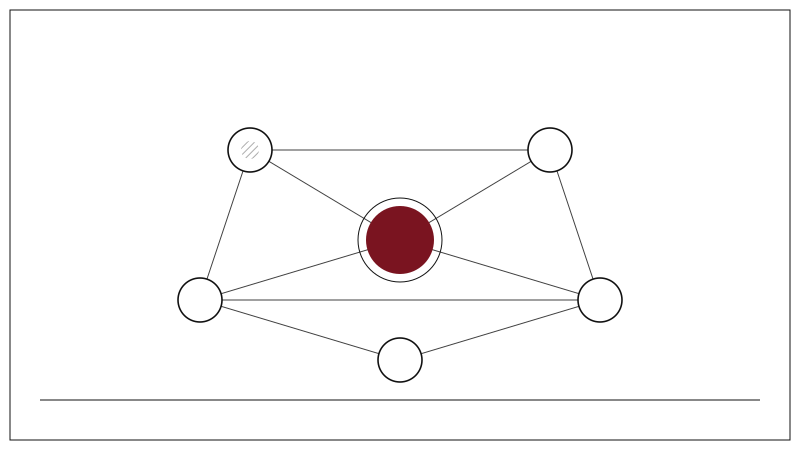
How do you get thousands of computers that don't trust each other, run by strangers all over the world, to agree on a single shared record — and keep agreeing, forever, even when some of those computers are actively trying to cheat? That's it. That's the hard part. It's a decades-old question in my field called consensus, and crypto pushed it into a much harsher setting than academia ever did: fully open, adversarial, with real money on the line. That pressure produced some real advances.
The casino is so loud you can't hear the engineering. But the engineering problem would be interesting even if the tokens were worth nothing. Dr. Elena Vasquez
Give me an example of a real advance.
The way the field has iterated on consensus mechanisms under real-world load has been genuinely instructive. Ideas that were textbook abstractions — how to tolerate a certain fraction of malicious participants, how to finalize decisions quickly without a central coordinator — have been stress-tested at a scale and under incentives that a research lab could never reproduce. Whatever you think of the applications, we've learned real things about building resilient distributed systems. Some of that will outlive crypto itself and end up in ordinary infrastructure.
And what's overstated? Where does the hype outrun reality?
The claim that this technology is about to reorganize the entire economy. Most things do not need this machinery. Consensus among mutually distrustful strangers is expensive — in energy, in complexity, in speed. If you have a trusted party, or you can establish one cheaply, a boring central database beats a blockchain on every axis that matters. The technology is a specialized tool for a specific, fairly narrow problem: coordinating without trust. A lot of projects are using a very expensive hammer on things that aren't nails.
How do you tell the narrow cases where it's the right tool?
Ask two questions. First: is there genuinely no party everyone can trust, and no cheap way to create one? Second: is the coordination problem valuable enough to justify the overhead? If the honest answer to both is yes, you might have a real use case. If you're reaching for a justification — "well, in theory, a malicious actor could —" you probably don't. The good applications don't require you to squint. They're situations where trustlessness is the actual product, not a garnish.
The energy criticism has followed this field for years. Where do you land on it?
It depends entirely on which consensus mechanism you're talking about, and this is where public understanding lags reality badly. The early, proof-of-work designs were genuinely enormously energy-hungry — that criticism was fair and I made it myself. But the field responded. Newer designs achieve security with a tiny fraction of the energy, and a lot of the ecosystem has migrated to them. So "crypto wastes energy" is now a bit like saying "cars pollute" — true of some, increasingly false of others, and you have to be specific. What frustrates me is that the debate is often a decade out of date on both sides: critics cite the worst old numbers, and boosters pretend the problem never existed. The honest position is that it was a real problem, engineering substantially addressed it, and the remaining questions are narrower and more interesting than the shouting suggests.
Is there a use case that genuinely persuaded you — one where you thought, yes, this is the right tool?
The ones that hold up for me tend to be unglamorous. Coordinating a record across institutions that are rivals and have no natural referee — where each participant would refuse to let any of the others host the master copy. That's a real trust vacuum, and it's the shape of problem this technology was actually designed for. It's telling that the persuasive cases are almost never the ones with the loudest marketing. The loud ones are usually consumer products bolting a blockchain onto something that a normal database would run better. The quiet ones, in back-office coordination between distrustful institutions, are where I've seen the technology earn its keep. Not exciting. Just correct.
You're clearly skeptical, but you're still in the field. Why?
Because the core problem is beautiful and unsolved in the general case, and I'm a distributed-systems person — this is the most interesting open-air laboratory my field has ever had. I can be skeptical of ninety percent of the ecosystem and still find the remaining ten percent worth my career. Those aren't in tension. In fact I'd argue the skepticism is required to do good work here. If you're emotionally invested in the price, you can't think clearly about the engineering.
If you're emotionally invested in the price, you can't think clearly about the engineering. Dr. Elena Vasquez
What would you say to a young researcher trying to decide whether to work in this area at all?
I'd tell them to come for the problems and stay skeptical of the culture. The technical questions are first-rate — genuinely among the most interesting in distributed systems right now. But the surrounding ecosystem has a lot of money sloshing around, and money distorts how people talk, what gets funded, and which results get hyped. A young researcher can do superb work here if they treat the hype as noise to be filtered rather than a signal to be chased. The ones who get into trouble are the ones who start believing the marketing, because then they stop testing their own assumptions. My advice is boring: read the papers, run the experiments, ignore the price charts, and let other people get rich quick while you try to get something right slowly.
Last question. If a smart, non-technical reader takes one thing from this conversation, what should it be?
That "crypto" is two different things wearing the same name, and you should mentally separate them. One is a speculative asset market with all the drama that implies. The other is a slow-moving research program on how to coordinate without trust. Judge them separately. Be as skeptical as you like about the first. Stay a little curious about the second — that's where anything that lasts will come from.
This interview has been edited for length and clarity. Dr. Vasquez reviewed the transcript for accuracy prior to publication.

Priya interviews researchers and founders across technology and biotech. Read her profile →